
Showing posts with label Siberian iris. Show all posts

Monday, April 18, 2011

There's An App,Oops---Iris For That!

Tall bearded iris

You may have heard a commercial where they repeat the phrase "There's an app for that." In case you don't know, app is short for application used in computer software designed to help a user perform a specific task and most recently for iPhones and iPads. At Pittsgrove, John and I often hear people say "I love iris, but my property is too wet" or in other cases, "too dry" or "too shady". Well, we have an iris for that!

Bearded iris are perfect for those full sun, very dry areas and range in size from border friendly Lilliput dwarf to background size tall bearded, all of which are available in a wide array of colors.
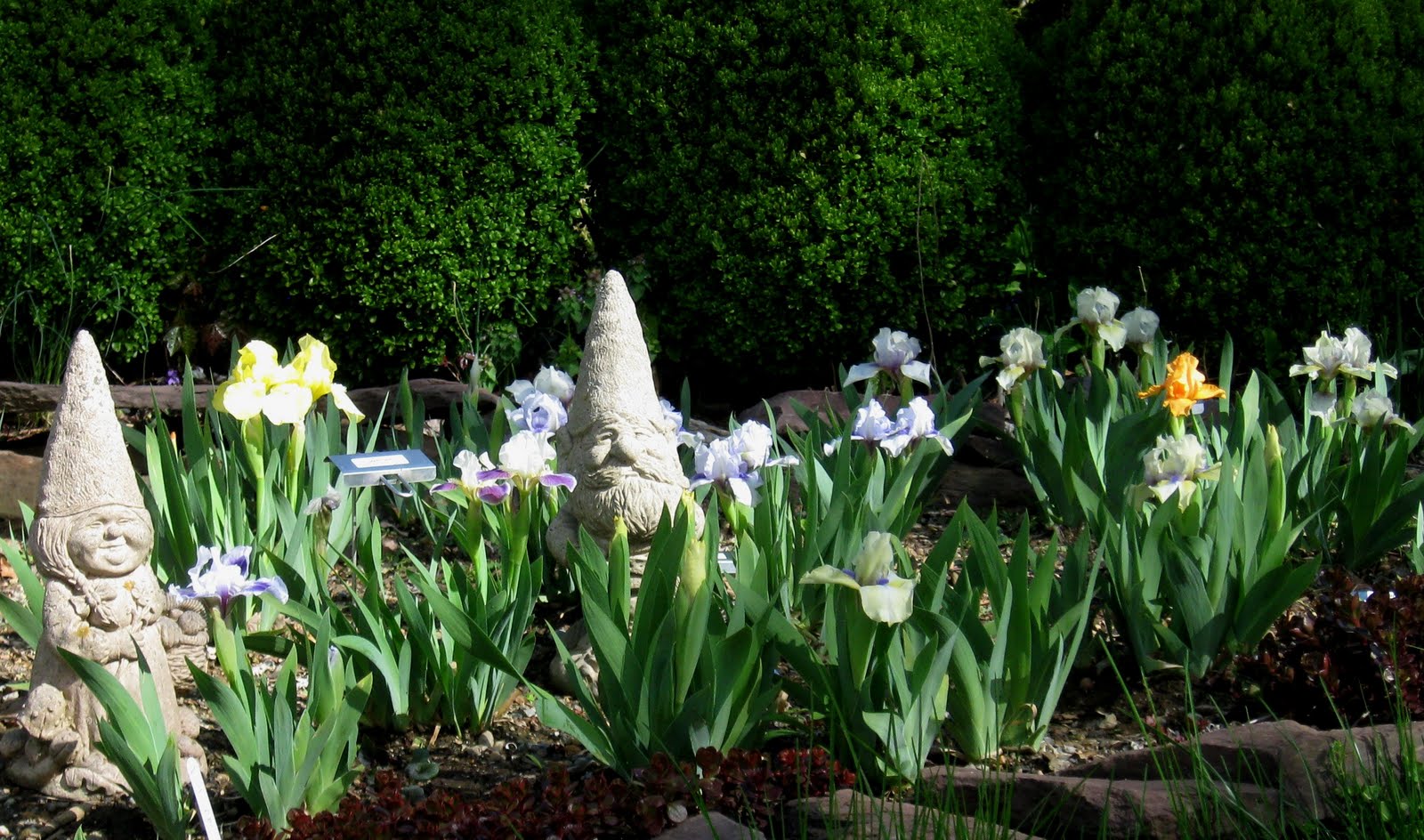
Dwarf bearded iris with friends

Moisture loving Louisiana and Japanese can be ideal for those areas where you may have difficulty growing plants due to periodic wet conditions. Louisiana, pseudacorus, and versicolor can actually sit in water.
Iris laevigata and pseudacorus

Siberian iris flourish in most common garden areas, blooming well in both full sun and part shade and have grassy foliage that looks attractive even when not in bloom.
Siberians on display

Really short on sun, then iris cristata may be just what you are looking for since these jaunty little, rapidly spreading iris are well-suited for that shady glade on your property.
Iris Cristata

John and I know nothing about apps, but we do know iris and with so many options available, there is sure to be the perfect iris awaiting a home in your garden. And for those of you who are tech savvy, I'm sure there's an app for that!

Happy Spring!
Cheryl

Monday, April 27, 2009

Dig It - Baby Sister Siberian Iris


Tell me, who doesn't like babies? I've made enough references in the past that by now you know I have an affinity for the petite plant varieties. Baby Sister, a dwarf Siberian iris, is my pick for this week. She certainly holds her own against her taller sister and brothers in a garden, has a lovely blue color, and blooms profusely. This sturdy little plant looks good at the garden edge or as part of a rock garden.

Baby Sister with Hubbard in the background at sunset at Pittsgrove Farms

Monday, April 6, 2009

Dig It-Shaker's Prayer


When someone mentions Siberian Iris, usually what comes to mind is Caesar's Brother, the most commonly found in garden centers and big box stores. Although quite hardy and attractive in its own right, there is much more to the Siberian world than this deep blue variety.

One that we are highlighting today is award winning Shaker's Prayer. This 36" iris is one of the first Siberians to make its appearance in spring. The heavily veined violet-blue blossoms have an almost wildflower look as they tower above their foliage, making one think of a meadow in bloom. The plant itself is quite hardy with the slender, attractive stems and foliage that Siberians are known for as opposed to the heavier stems and leaves of their bearded cousins. You won't have to get down on your knees and pray for flowers since Shaker's Prayer is one of the most prolifically blooming Siberian irises.

Saturday, June 14, 2008

Hurray for the Red,White and Blue! Iris, Peony and Daylily Edition

Today, June 14, in honor of Flag Day I'm featuring red, white, and blue flowers that can found here at Pittsgrove Farms.

Red at Night


Gull's Wings


Speeding Again

Earlier in the season red could be viewed in the bearded iris beds in the form of Red at Night and Classic Bordeaux, followed by Siberian Iris Eric the Red, and peonies, Big Ben, Karl Rosenfield, and the most red peony, Many Happy Returns. As their blooms have faded, Red Rum and Pardon Me are making themselves known in the day lily beds.


Red Rum


Shirley Temple

White Immortality not only bloomed in the spring, but as a tall-bearded re-bloomer will greet us again in late summer or early fall. Gull's Wings, Bridal Jig and Snow Queen Siberians stand tall in the garden showing off their snowy brilliance. Not to be outdone, Shirley Temple, Bowl of Cream, My Love, and the old standby Festiva Maxima peonies showed off their various shades of white.

Lastly, dark blue Davey Jones and light blue Fathom prove to be prolific, reliable Intermediate Bearded, while Last Hurrah and Speeding Again stand tall in spring to return again in the fall. Siberians are well represented by Steve (who thinks of these names?) and later bloomers are Louisiana Gulf Shores and Center of Interest Japanese irises.

While honoring our flag today, I would like to call attention to a site, eMailOurMilitary.com I was made aware of my dear friend Liz who blogs at This Full House, and all the details can be found on her site.

Thousands of servicemen and women serve our country proudly displaying the flag on their uniforms. eMailOurMilitary.com is an attempt by a military wife to connect Americans with them, especially folks who may not be receiving much support from family back home. No matter what your political views, please go to this site and show our men and women that we appreciate the sacrifices they make daily throughout the world. While your at it, pass the site along to others in your address books or fellow bloggers. And, by the way remember to display Old Glory!

Wednesday, June 4, 2008

How to grow Siberian iris? - plant them near a drain


To continue on yesterday's Pittsgrove Farms - Home Edition theme as well as the theme of plants growing in tough places, I thought it appropriate to talk about a winner in my garden that grows in a typically challenging spot. With the rather cool spring we have experienced, New Jersey Siberian iris are just starting to come into full bloom. Of all the iris that are planted at our house, none has done better than the Snow Queen Siberian iris.

The flower is a vibrant pure white. White standards with wide flaring falls are highlighted at the center with bright sunflower yellow. When planting Siberian iris it is vitally important that the roots do not dry out when they are first getting established in the garden. Though they don't like to be planted in standing water, they will flourish around the edge of ponds or at the edge of a stream. Once iris establish themselves they can grow well in a dry area. Greg at The Midnight Garden shows some beautiful examples of Snow Queen Siberian iris (we think) flourishing in a dryer area.


Considering their thirst for water, it is no wonder why, the Siberian iris planted near my gutter drain have done so well. The gutter and iris have a symbiotic relationship - the white gutter drain pipe waters the iris, the iris grows beautifully and hides the unsightly drain pipe. Who said it isn't good to have your mind in the gutter?

Unlike bearded varieties where the rhizome should be exposed, the crown of the Siberian iris should be planted about an inch deep. They should be mulched especially when first planted to maintain moisture; in winter they should recieve a slightly heavier layer in an effort to protect newer plants. More tips on planting Siberian iris and other types are available here.

Happy Gardening!

Tuesday, June 3, 2008

Blooming iris, ground covers and crack fillers

As we are always sharing pictures from the farm, I thought it was about time to show how the plants from the farm grow elsewhere - specifically at my house.

I have had the privilege to steal at no cost the plants from my parents' garden. A lot of the perennials at our house in Morristown such as the Iris Pallida Variegata, Snow Queen siberian iris, lily of the valley and others were first rooted at the Hunterdon County nursery. This is especially true of our groundcovers.

Two years ago my father and a friend helped put in a natural, blue stone patio. My wife, who is an engineer is more partial to order and symmetry - bricks, pavers or any type of concrete tessellation are much more to her liking. For me, the PR "creative" guy, I liked the piece-it-together look (plus it was the cheap option).

This led to a patio that inevitably would be slightly uneven and with its share of cracks between the slabs of rock. The fact that the stone fit together, is a lot less amazing than the fact that some plants despite being tromped by footsteps, planted in a terrible combination of stonedust and dirt can actually survive and flourish.

Walkway onto the patio.

The Wholly Thyme has spread, well, like a weed. Though it has no more than 4 inches wide of soil, it has spread a couple feet across. As they were planted in the fall following the construction, it has only been rooted for a year and a half. Hopefully, the new quart-sized Wholly Thyme and Irish Moss will flourish as well as the veterans.

Just takes a little "thyme" for it to take off.

A more upright variety of creeping thyme has done extremely well despite my wife's aversion to it. It grows roughly 6 inches or higher in the summer, which is too high in her opinion. I am starting to come around to agreeing after watching friends walk on the patio like it was a mind field. It has filled in the cracks of the patio and has started spreading seedlings through out many other areas - just our luck...

Only a matter of Thyme before it takes over.

More to both of our tastes, Creeping Jenny has done well in the patio and offers great color. Hopefully it will take off like a yellow carpet that will be able to handle the footsteps to and from the park and pond behind our house. We don't have much of a yard but at least we have one heck of a view.

Creeping into the park it doesn't take long for Creeping Jenny to take off.

Walkways leads to view of Burnham Park


Saturday, May 31, 2008

Wildlife Comes Alive at Pittsgrove Farms

New Jersey gets a bad rap for being a mafia ridden, wasteland of industry and highways. Those of us that live here know why it is affectionately called the Garden State.

We have always embraced the nature of Hunterdon County. This year more than ever (probably because we are outside more than ever) we have seen all kinds of wildlife. From orange-winged orioles to the occasional fox, we get to experience the wonders of Mother Nature beyond the blooming iris, peonies, and other perennials though they sure are nice too.

Just today we came across a running box turtle, (very slowly running, but running nonetheless by turtle standards), a flying gray heron, many many frogs, and a nesting Killdeer.

The Killdeer, which is named for its loud piercing "kill-deer" call, is a rather unusual bird as it is comfortable nesting close to humans and often make nests on the ground. What makes this bird even more interesting is its broken-wing act. When humans or predators come near, the Killdeer will pretend to act injured in an effort to draw the predator away from its nest. Despite the evolutionary genius that has help ensure that its young survive, it is quite funny to watch as it looks something similar to a country line dance by a bar patron who has had a few too many.

Can you find me? The Killdeer remains camouflaged in the overgrown daylily beds. Pardon the weeds, but how would you like it if someone started ripping up your home?
The Killdeer, who has made a home in our daylily fields, lives close by to the frogs. The frogs have made the small pond near the driveway home. For years, the area next to the entrance to Pittsgrove Farms was a natural wet spot that filled after even a short drizzle. Instead of letting it remain as an overgrown ditch, we have transformed it into a pond filled with waterlilies and frogs, and surrounded by Siberian iris, Japanese iris, water iris and wet tolerant perennials.

A pretty nice ditch - the water lilies have just started to bloom next to the pot of very old papyrus. In the foreground, Ruffled Velvet Siberian iris comes into bloom.
In hopes of making the area an even greater refuge for our plants and animal friends, we plan on extending the natural pond by simply defining the edges more and adding some plastic to maintain the water during the dry season. After all, isn't it nice having company in the garden?

Rippit! Ribbit! A frog sunbathes on the rock behind some blooming iris laevigata variegata.


Creeping Jeremy sneaks up on the frog for an extreme closeup, as it sits on a rock laced with water-loving Creepy Jenny.